There are moments in football when the air changes. You feel it before you see it. A ripple through the stands. A murmur that doesn’t belong to the game. And then—there it is. Footballs spilling onto the pitch, not as celebration, not as humour, but as a message.
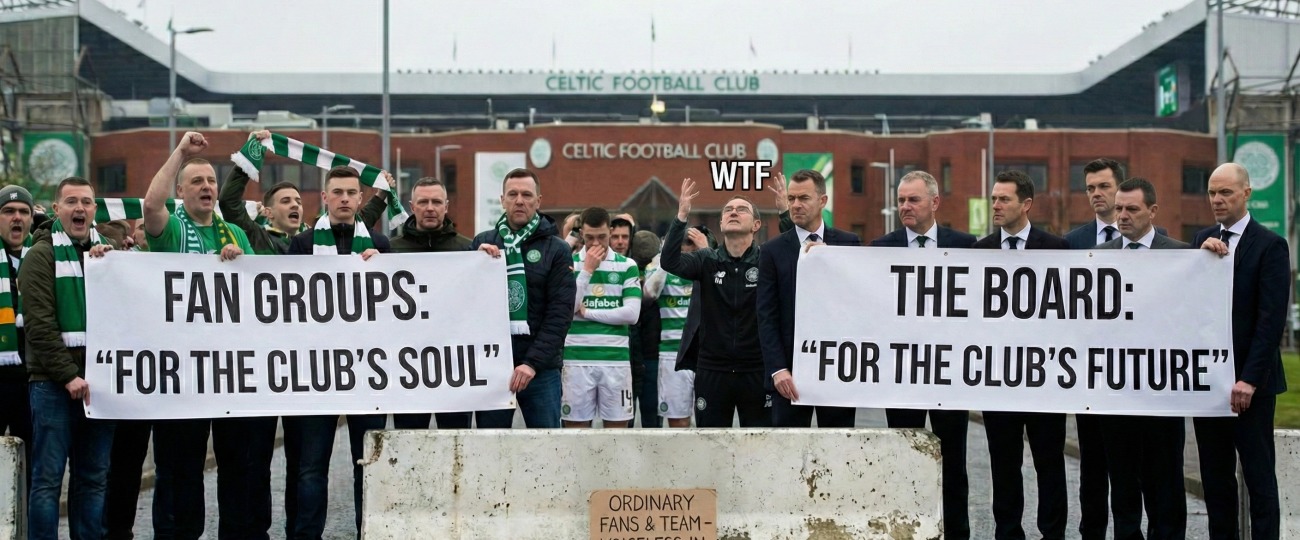
Martin O’Neill, caught on camera about 25 seconds after being told there was a protest, wearing the face every ordinary supporter has worn at some point in the last while: disbelief, anger, and a kind of gutted sadness that doesn’t fit into chants or slogans. That split second said everything. Not because he’s some saint, not because managers are above it all—but because it was a pure human reaction to something that should never be normal at a club like Celtic.
And this is the hard truth: we’ve got two groups who are convinced they’re the grown-ups in the room. Two factions that speak like they own the moral high ground. Two sides who claim they’re acting “for the good of the club”. And the club I love is being torn apart between them—while the team and the ordinary fans stand in the middle with no real voice, no real power, and no way to win.
On one side, the protest culture. The self-appointed gatekeepers. The people who are always the loudest, always the most certain, always the quickest to tell you that if you’re not with them, you’re against the club. They don’t see themselves as a faction—they see themselves as the conscience of Celtic. And sometimes, yes, supporters have been the conscience of Celtic. We’ve stood for things bigger than football. We’ve carried the club when others would’ve sold its soul.
But here’s where it goes wrong: righteousness becomes performance. Anger becomes identity. The cause becomes a brand. And then the point stops being “protect the club” and starts becoming “prove we’re the purest supporters in the room.” The footballs on the pitch aren’t just a protest tactic—they’re a symbol of a culture where disruption is treated like leadership. Where volume substitutes for accountability. Where the match-going fan who just wants to support the team is told to pick a side or shut up.
On the other side, the boardroom comfort. The quiet certainty that they know best because they hold the keys. The suits who talk about sustainability and models and revenue streams while the soul of the place is reduced to a line item. They’ll tell you that they’re protecting Celtic from being reckless, from chasing every short-term whim, from letting emotion dictate decisions. And sometimes they’re right—clubs get ruined by gamblers and fantasists.
But here’s where they go wrong: they treat supporters like a resource to be managed rather than a community to be respected. They hide behind silence. They communicate when it suits them and disappear when it doesn’t. They confuse “stability” with “entitlement”. They mistake a loyal fanbase for an endlessly patient one. And when conflict rises, they don’t engage like leaders—they wait it out like landlords. That distance, that coldness, that refusal to meet the emotion of the club with any human truth, is petrol on a fire.
And then there are the “top people” on both sides. The ones who love the drama a wee bit too much. The ones with an eye on a prize—whether it’s influence, reputation, future roles, a political identity, or a personal vendetta dressed up as principle. You see it in the language: constant certainties, constant purity tests, constant insinuations about anyone who disagrees. Some orbit the Desmonds as if proximity to power is a badge. Others posture like intellectual saviours—lecturers, commentators, organisers—speaking for “the supporters” while treating actual supporters like an audience.
The ugly part is this: it becomes a game. A power struggle. A theatre. And in the middle of that theatre are the players—human beings asked to perform under a cloud of conflict they didn’t create. A manager trying to focus on a match while being told, mid-flow, that the stadium is about to become a statement. Ordinary fans who’ve saved money, travelled, brought their weans, just wanting ninety minutes of belonging—dragged into a war they didn’t vote for.
That’s what hurts most. Celtic is supposed to be a shared identity. A place where differences melt into something bigger when the whistle blows. But right now, too many people are using the club as a battleground for their own certainty. And the rest of us—normal fans who love Celtic but don’t want to spend our lives in a permanent argument—are treated like we’re naive, or complicit, or not “real” enough.
Here’s my plea, and I mean it: stop treating the team as collateral. Stop turning match day into a stage for factional dominance. Protest if you must, demand standards if you must—but don’t pretend that chaos is consequence-free. And boardroom: stop acting like silence is dignity. It isn’t. It’s arrogance in a tailored suit.
Because the club doesn’t belong to the loudest protesters or the quietest directors. It belongs to the people in the middle—the ones who show up, who care, who hurt, and who’ve had no real voice while the grown-ups throw their toys (and their footballs) onto the pitch.
What a load of balls, indeed.







 Written by